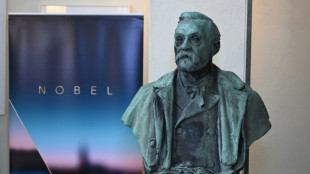
Anne Carson: modern takes on Greek classics / Photo: Jonathan Nackstrand - AFP

Canadian-born poet, essayist and translator Anne Carson, who was awarded the Nobel Prize in Literature on Thursday, brings a modern twist to mysticism and antiquity in her unclassifiable writings about love, desire and despair.
A professor of classics with a background in dead languages, literature, anthropology and history, she was described by The New York Times in 2001 as "one of the great pasticheurs."
Her work, however, was ignored for years, until a series of recent critical and commercial hits -- including the Princess of Asturias Award for Letters in 2020 and now the Nobel Prize.
The 76-year-old Carson is notoriously private, preferring interviews by email from her home in Ann Arbor, Michigan, where she lives with her husband.
Among her many admirers are literary luminaries Alice Munro, Michael Ondaatje, Harold Bloom and Susan Sontag.
"She is one of the few writers writing in English that I would read anything that she wrote," said Sontag, quoted in The New York Times in 2000.
"When you're reading her work, you're taking in a huge range of intellect and wit and emotion, which are not usually found in the same person," said Ondaatje, also quoted in the Times.
- Inspired by the ancients -
Born in Toronto on June 21, 1950, Carson is the second child of a banker and a housewife.
She was introduced to Hellenic literature, which deeply influenced her writings, by a Latin instructor in high school who agreed to tutor her during lunch hours.
Carson twice dropped out of university before returning to complete her doctorate. She went on to teach at several respected universities in Canada and the United States, including the University of Michigan in Ann Arbor.
Her publishing career began in 1986 with "Eros the Bittersweet: An Essay," which charts the concept of "eros" in ancient Greek poetry and showcases her unique approach.
"In the abbreviated, free-associative mode that she instantly established as her trademark, any thought might set off any other thought, or even a demi-thought," said the Times in 2001.
- Opposites attract -
Carson's unique contemporary poetry earned her several key literary prizes in the 1990s, including the 1996 Lannan Award and the 1997 Pushcart Prize.
A year later, "Autobiography of Red: A Novel in Verse" -- loosely based on the Greek myth of the monster Geryon and Herakles but transformed into a modern tale of a gay love triangle -- received widespread praise.
"She brings the ancient Greeks alive, and makes them speak in the 20th century without betraying what's been bequeathed to us from antiquity," said academic Emmet Robbins in the Times in 2001.
"Men in the Off Hours" (2001) is a collection of poetry and prose in which Carson characteristically mixes opposites -- classical/modern, cinema/print, narrative/verse -- and reimagines famous figures.
In 2001, Carson also became the first woman to receive the T.S. Eliot Prize for Poetry, and in 2010 she won the PEN Award for Poetry in Translation.
- Timeless struggle -
In 2014, Carson received a second Griffin Poetry Prize for her verse novel "Red Doc>," a kind of sequel to her acclaimed "Autobiography of Red."
"To engage so fluidly, so originally and compellingly, with a story first told more than 3,000 years ago, is astonishing: her ambition is one thing; the fact that it is so completely achieved is, frankly, something else," said The Guardian in 2013, the year the book was published.
Her spoken and sung performance piece "Norma Jeane Baker of Troy," released in 2019, was inspired by Euripides' "Helen." Carson superimposes Marilyn Monroe over the legendary character from Greek mythology.
And then in 2021, she released "The Trojan Women: A Comic" -- a comic book reimagining of the Euripides classic.
Despite her exceptional writing skills, Carson says she struggles with language, its inaccuracy and clumsiness.
"We're talking about the struggle to drag a thought over from the mush of the unconscious into some kind of grammar, syntax, human sense," she told The New York Times in 2013.
"I feel I am blundering in concepts too fine for me."
T.Vogel--FFMTZ