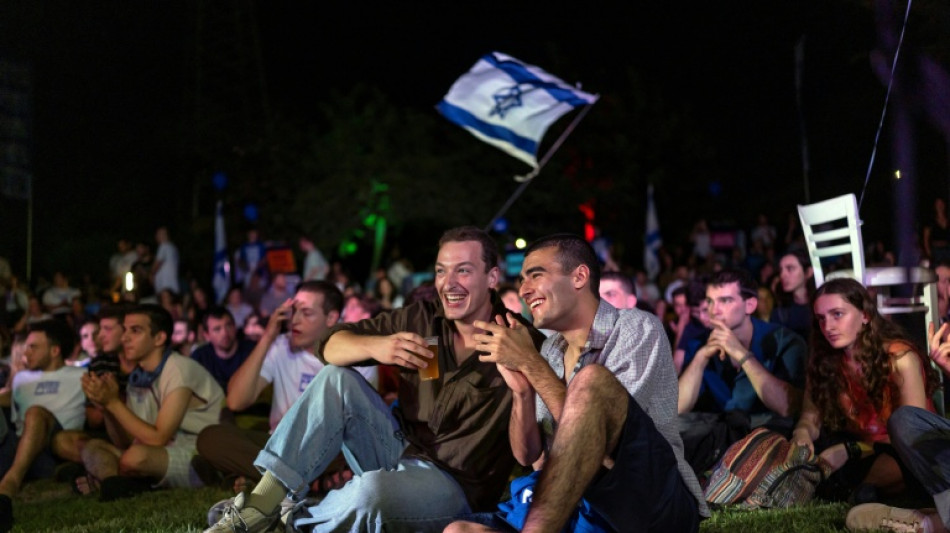
October 7 scars push Israel's first-time voters to right / Photo: Ilia YEFIMOVICH - AFP

Like hundreds of thousands of Israelis, Amihai will be of voting age for the first time since Hamas carried out its attack on October 7, 2023. When he casts his ballot this month, he has one priority above all -- security.
From a field overlooking the sprawling ruins of the northern Gaza Strip, the 18-year-old says he plans to vote for a far-right party at the ballot box, three years after the deadliest day in Israeli history.
"I'm voting based solely on security -- not for whoever will help me buy an apartment in 10 years, but for whoever can guarantee that I'll even still be alive here in 10 years," he told AFP.
Amihai, from Shomria in southern Israel, was speaking less than two kilometres from Gaza, swathes of which have been flattened by Israeli bombardment since the war with Hamas erupted in 2023.
He was attending an event calling for Jewish settlement of the Palestinian territory, and said that on October 27 he would be casting a vote for the ultra-nationalist party of National Security Minister Itamar Ben Gvir.
"After October 7, I want death for the terrorists, I want the terrorists here to suffer in prison, I want there to be deterrence," the teenager said, alluding to a recently passed death penalty law that applies to Palestinians.
Sporting a cap and T-shirt in support of the minister, Amihai said he also wanted "emigration from Gaza, that the people of Gaza will be dying to leave" -- another policy advocated by government ministers in recent months.
Roughly 550,000 Israelis aged between 18 and 22 will be voting for the first time in October, according to Israel's Channel 12.
In a recent poll commissioned by the channel, 74 percent of first-time voters described their policy views as right or centre-right -- an even higher share than the broadly right-leaning public at large.
- 'Real future' -
The trend stands in contrast to many Western democracies where young people are among the most left-leaning voters -- with some in recent years motivated by outrage over Israel's actions in Gaza.
But the right-wing turn of Israeli Jewish youth has been building for around two decades, said pollster and analyst Dahlia Scheindlin.
"Older people... remember the hope of reaching full, comprehensive peace agreements with the Palestinians," Scheindlin told AFP.
"Anybody who's an 18-year-old now, his or her entire political consciousness is under (Prime Minister Benjamin) Netanyahu, it's a very ultra-nationalist environment," she said.
"Peace is not in people's minds."
At a gathering of young activists for the centre-left Democrats party in Tel Aviv last month, 18-year-old Gili said she felt society had turned its back on peace.
"I think especially young people, when they see something so huge happening, something that hurts so deeply and affects everyone, like what happened on October 7, then the first tendency is fear, to be afraid, and not to believe that peace is possible," she told AFP.
"It's really logical that everyone kind of became more and more right-wing, and more and more extreme."
Hamas's October 7 attack resulted in the deaths of 1,221 people, according to an AFP tally based on official Israeli figures.
In response, Israel launched a massive military offensive that has killed more than 74,200 people in Gaza, according to the health ministry there, which is under Hamas authority and whose figures are considered reliable by the United Nations.
Gili and her friends at the rally said they supported the Democrats' vision of a political agreement with the Palestinians.
"Conflict management is not a solution, and I don't think the current situation can go on," said Yuval, an 18-year-old from kibbutz Tel Yitzhak in central Israel.
"Certainly not if we want to raise our children here, if we want to believe we have a real future for ourselves".
- 'Win decisively' -
For yeshiva student Yishai Neeman, who hopes soon to enlist in a combat unit in the Israeli military, the horrors of October 7 and the wars that followed strengthened his resolve to fight for his country.
Neeman, who is now 19, was at a synagogue when he heard of Hamas's attack and spent his final years at boarding school running to bomb shelters.
From his home in the central city of Petah Tikva, Neeman said he would be voting for the Religious Zionism party of far-right Finance Minister Bezalel Smotrich.
Neeman said he wanted peace, but felt it wasn't possible under the current conditions. Israel should annex the occupied West Bank, he said, and "erase their hope for a Palestinian state".
Soon heading to fight himself, Neeman said he wasn't in favour of endless wars, but that Israel "can't return once more to the understanding that preceded October 7".
"That's why now we must fight and win decisively."
I.Schulz--FFMTZ