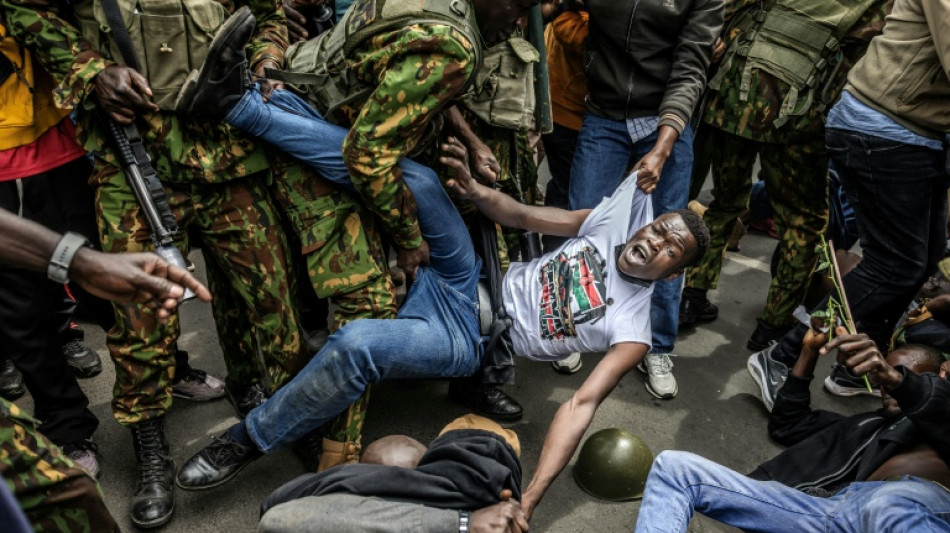
Kenya police turn out in force on protest anniversary / Photo: Luis TATO - AFP
Kenyan police mounted a massive security operation Thursday, blocking off much of the capital in a bid to prevent protests marking two years since a landmark "Gen Z" uprising.
Thousands of Kenyans took to the streets in June 2024 against economic hardship and corruption, eventually storming parliament to force the cancellation of new taxes.
It was a watershed moment as young Kenyans rallied together, ignoring traditional ethnic divisions, and June 25 has become an annual day of protest thanks to ongoing frustration with the government of President William Ruto.
But they have paid a heavy price: at least 127 people were killed across the two years of protests, according to a police watchdog, as security forces shot people with near-total impunity.
The government Thursday closed off traffic on key roads around Nairobi, firing teargas at the first sign of groups gathering, while schools and businesses shuttered.
AFP journalists saw long lines of police wagons, horse patrols and large numbers of plainclothes officers.
"They know people are not afraid of police in uniform. But they are scared of these plainclothes cops because they can just kill you and go," said Moses, 31, a motorbike-taxi driver.
Many were too afraid to protest, with one young woman telling AFP: "I don't want to die, I'm the oldest. I just want to work."
A small group of activists and politicians managed to reach parliament to lay flowers for those killed two years ago, chanting: "This is not a police state."
"Life is so hard," said Jacinta Anyango, whose 12-year-old son Kennedy was killed that day, as she lay a white rose on the barbed wire around parliament.
At least three were arrested as mounted police dispersed the group.
Ruto is "a cold-blooded sociopath and a murderer. We are peace-loving Kenyans and we are saying stop police killings!" presidential hopeful Boniface Mwangi told the crowd.
- 'Organised terror' -
Ruto said this week that Kenyans had a right to demonstrate but warned against anyone "mobilised to destroy property or cause chaos".
Yet politicians have frequently deployed masses of hired "goons" -- armed men sent to attack opponents -- who are blamed for most of the looting and robberies during protests.
AFP saw scores of them operating alongside police during last year's protests and they have recently been used to attack everything from opposition rallies to civil rights meetings in churches.
Ruto's former deputy Rigathi Gachagua, now a bitter rival, warned young Kenyans not to protest on Thursday, saying: "I plead with you: stay at home. The state has organised terror against Kenyans."
At one roundabout, 25-year-old Kasim Ramadan gathered with four or five friends, determined not to be intimidated.
"There are way more police than usual. They already teargassed us before 8:00 am. But we're not scared," he told AFP.
- 'Clearly unpopular' -
Ruto has long been associated with violence -- he was charged with crimes against humanity by the International Criminal Court for inciting attacks during mass election unrest in 2007-2008, a case that was dropped after alleged witness-intimidation.
He has since reinvented himself as a business-oriented leader and a favourite on the international scene, recently hosting French President Emmanuel Macron for a major African summit.
But his promises of economic transformation have failed to register for many Kenyans, who accuse him of a string of broken pledges, corruption scandals and abductions targeting critics.
Ruto is "clearly very unpopular with many Kenyans, especially the Gen Z" youngsters, said political analyst Gabrielle Lynch.
She said he was "using security and intelligence services to make Kenyans worried about speaking out against the state".
But he has also offered an olive branch, last week announcing that more than 1,100 victims of violence would receive compensation.
"No other administration... has made payouts to victims of protests," said political analyst Javas Bigambo, also praising Ruto's ambitious plans to revamp social housing, health insurance and infrastructure.
But many fear those elections will see politicians mobilising ever-larger numbers of goons to protect themselves and attack opponents.
"I'm worried about next year... We know from history that once you've mobilised those groups, you can't always control them afterwards," said Lynch.
W.Werner--FFMTZ